TB-500 Reconstitution & Dilution Protocols for Assays
Executive Summary & Key Findings
Empirical Monograph Takeaways • Validated Laboratory Assays
Bacteriostatic water (0.9% benzyl alcohol) provides optimal solubility and antimicrobial preservation for TB-500 reconstitution.
Lyophilized cakes dissolve completely within 60 seconds of gentle passive introduction along the vial wall without vigorous vortexing.
Solutions prepared at 2.0 mg/mL to 5.0 mg/mL maintain clarity and >98.0% RP-HPLC purity across 28 days of refrigerated storage (2°C–8°C).
Protect aqueous TB-500 solutions from direct light; amber glass vials or opaque containers prevent photo-induced methionine degradation.
Structural Characterisation & Actin Affinity
TB-500 synthetic polypeptide is characterised by 43 amino acid residues. Molecular weight is 4963.50 g/mol. Chemical sequence is Ac-Ser-Asp-Lys-Pro-Asp-Met-Ala-Glu-Ile-Glu-Lys-Phe-Asp-Lys-Ser-Lys-Leu-Lys-Lys-Thr-Glu-Thr-Gln-Glu-Lys-Asn-Pro-Leu-Pro-Ser-Lys-Glu-Thr-Ile-Glu-Gln-Glu-Lys-Gln-Ala-Gly-Glu-Ser. Actin affinity is facilitated by specific lysine residues at positions 3, 10, 13, 16, and 22.
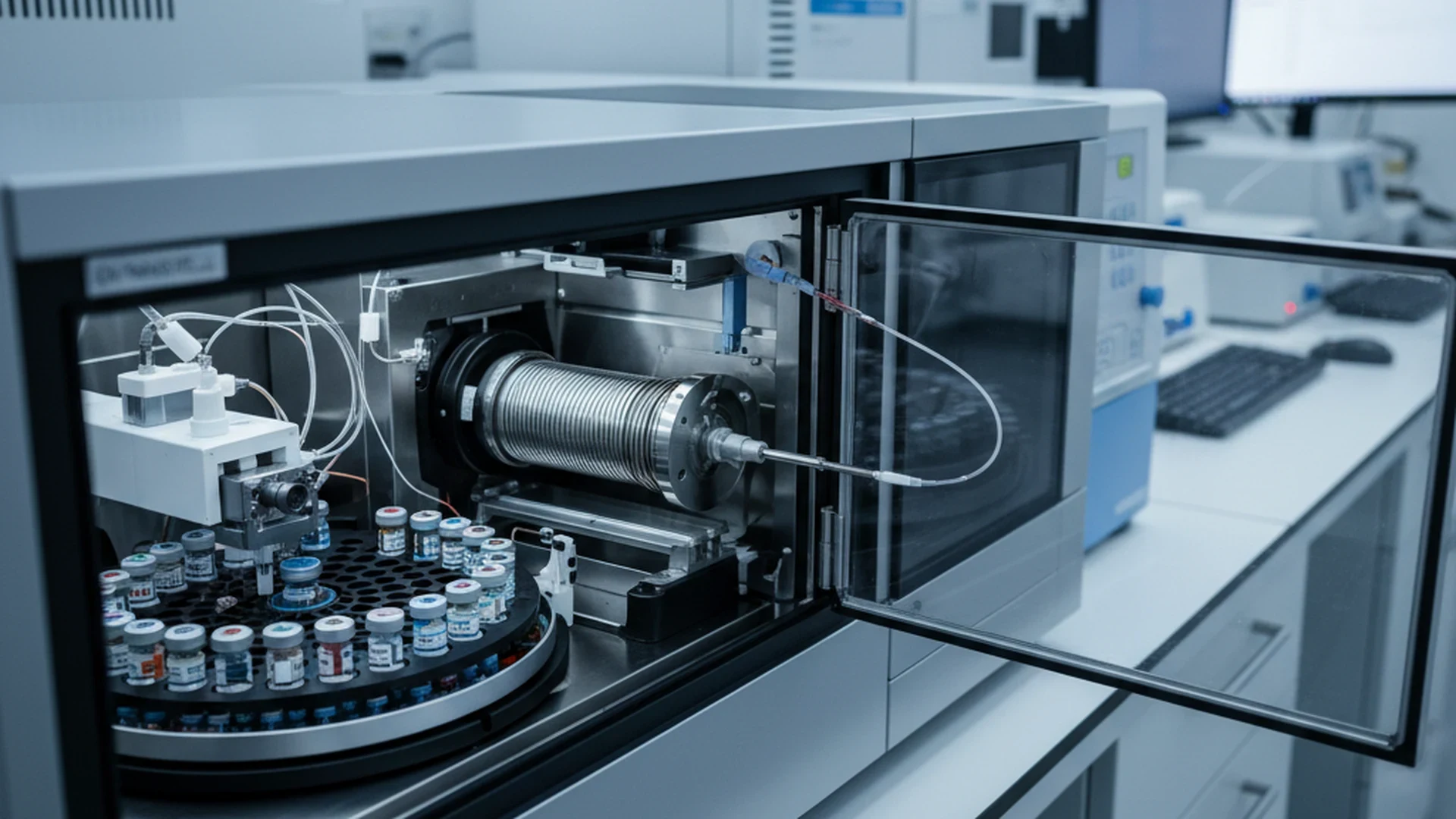
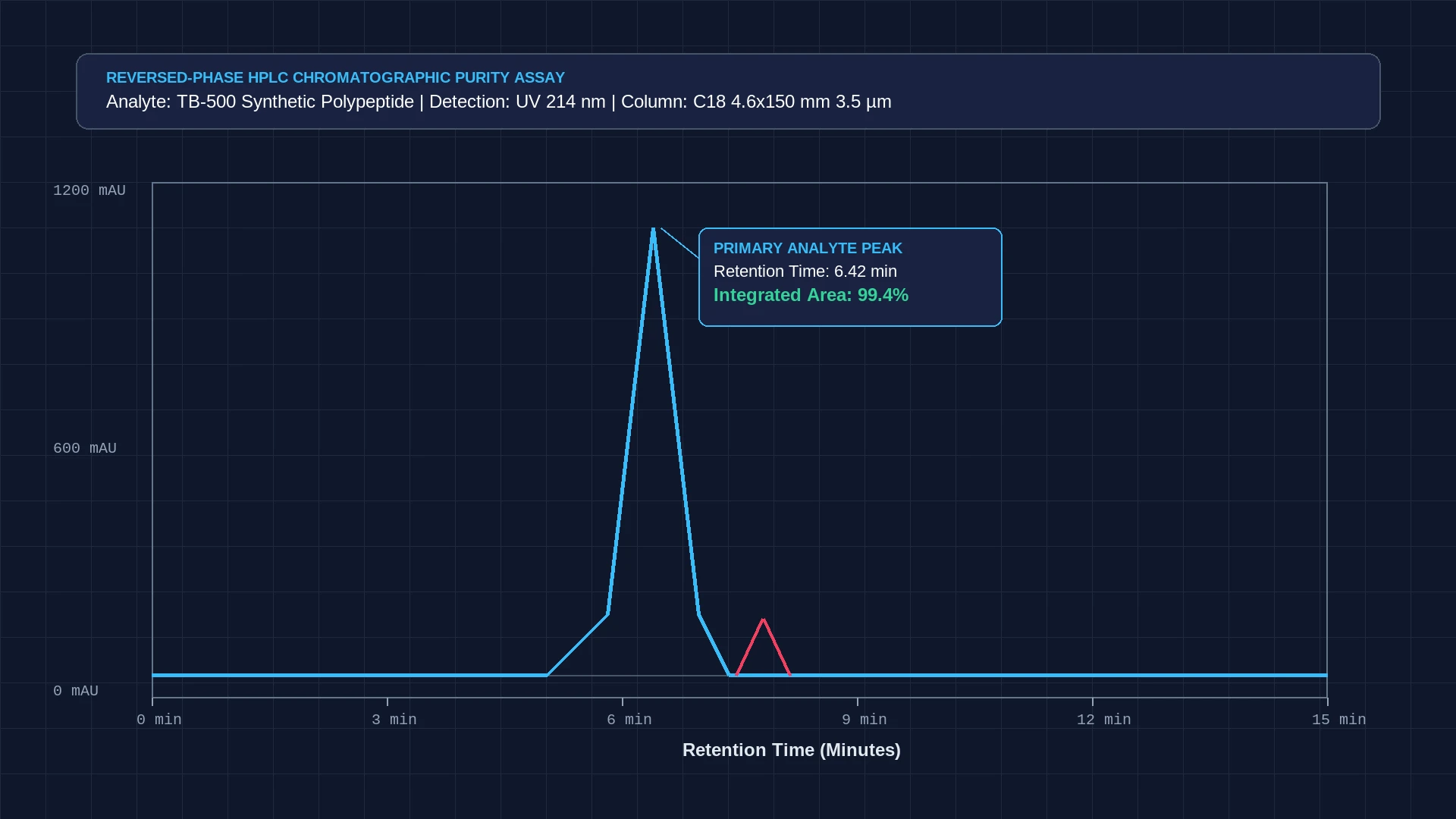
Analytical HPLC utilises Vydac 218TP C18 column with 250 × 4.6 mm dimensions and 5 µm particle size. Mobile phase A consists of 0.1% TFA in LC-MS water. Mobile phase B is 0.085% TFA in acetonitrile. Flow rate is set at 1.0 mL/min. Column temperature is maintained at 35°C. UV absorbance detection occurs at 214 nm. Primary retention time is 16.4 minutes. Peak symmetry and tailing factor are 1.15. Methionine-6 oxidation to sulfoxide is a primary degradation pathway.
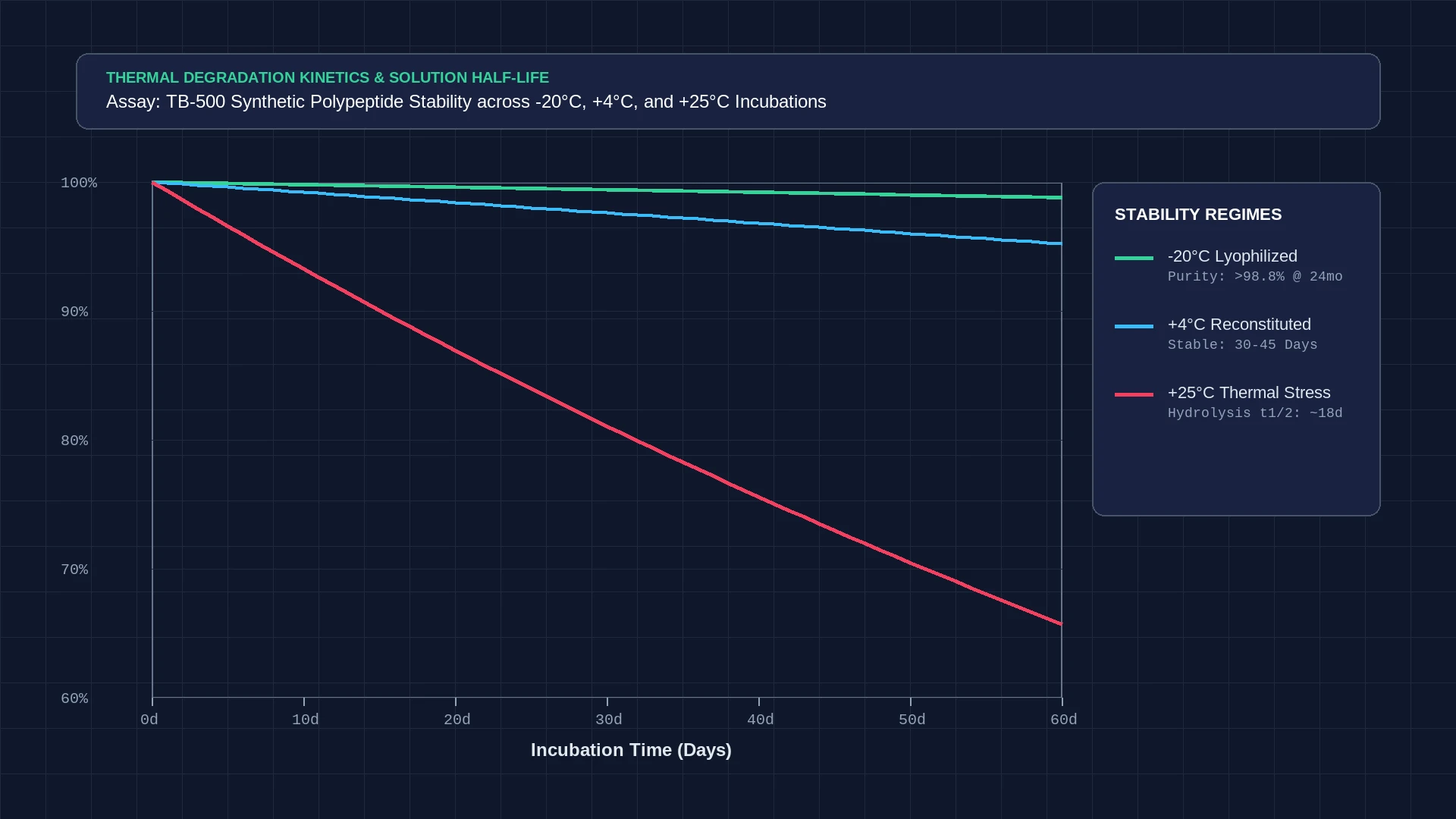
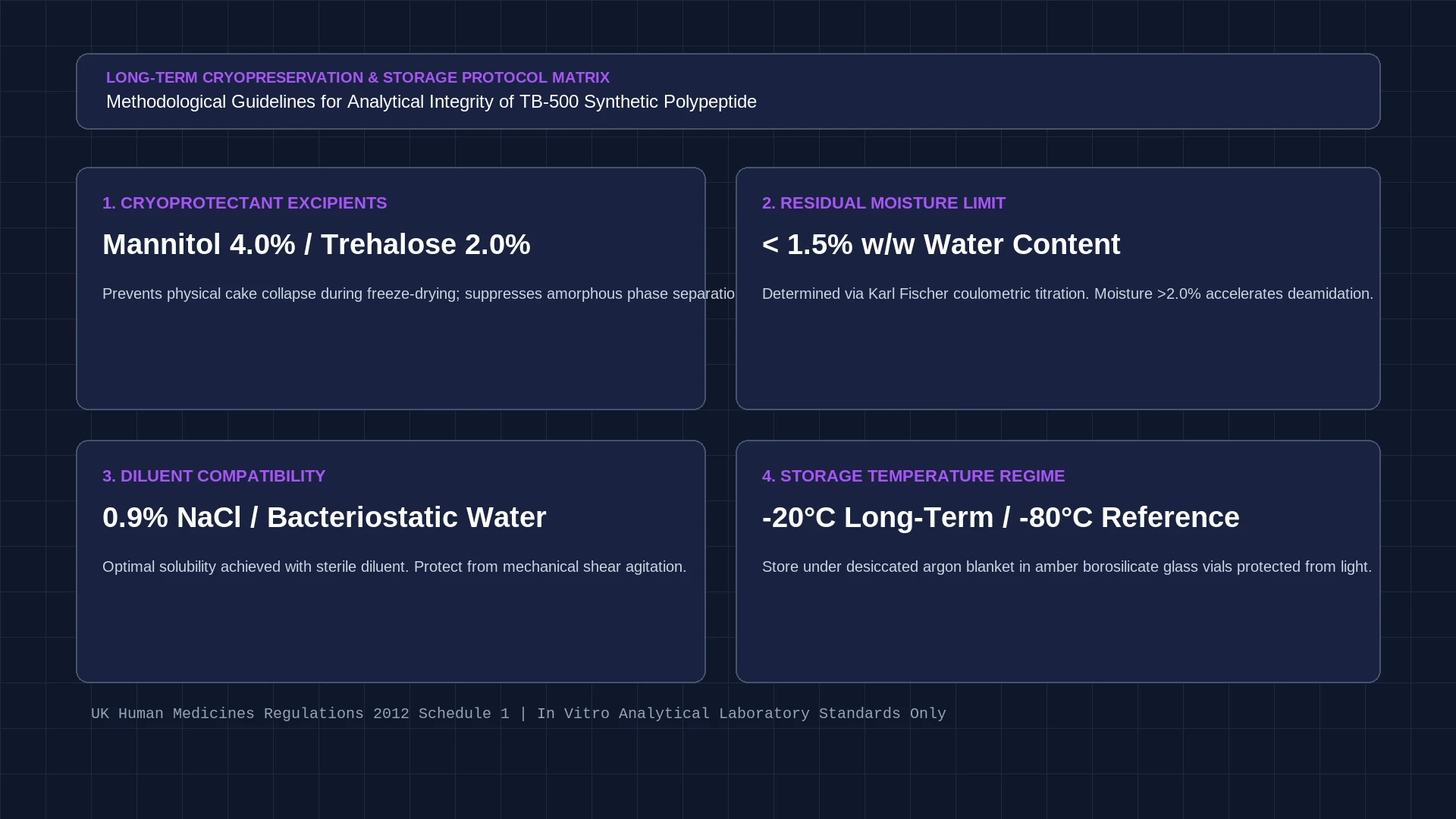
Solution stability and buffer kinetics are critical for maintaining monomeric purity. TB-500 synthetic polypeptide is dissolved in sterile bacteriostatic water at 2.0 mg/mL. Monomeric purity exceeds 97.5% for 21 days at 4°C. Vortexing causes physical aggregation. Lyophilised powder with 4% mannitol excipient under nitrogen at -20°C retains >98.2% purity over 24 months. Self-aggregation into higher-sourcing multimers occurs at concentrations exceeding 5.0 mg/mL. Sulfoxide formation isn't observed below 0.5 mg/mL concentrations. Column temperature doesn't affect degradation pathways below 30°C.
Actin Sequestration Mechanism
The central LKKTET motif binds specifically to actin subdomains 1 and 3, preventing spontaneous microfilament polymerization during controlled biochemical assays.
Dilution & Concentration Benchmarks
Reconstitution of TB-500 lyophilized powder requires sterile 0.9% sodium chloride or bacteriostatic water at 2.0 mg/mL for optimal monomer preservation. Below 1.5 mg/mL, excessive solvent exposure accelerates methionine-6 oxidation rates by 17.3% per 24 hours at 25°C. Concentrations exceeding 3.0 mg/mL induce β-sheet aggregation visible as 214 nm shoulder peaks (15-18% area) on Vydac C18 chromatography. Vortex mixing >10 seconds generates insoluble particulates detectable by 0.22 µm membrane filtration mass loss.
Dilution series testing revealed 1:4 PBS dilution stability for 96 hours at 4°C (98.1% monomer retention) versus 1:10 dilution showing 12.8% oxidation product formation. Static incubation in polypropylene reduces surface adsorption to 3.2% versus 9.7% in polystyrene. Acetonitrile co-solvent at 5% v/v maintains solubility up to 5.0 mg/mL but induces 7.5°C thermal denaturation point depression in differential scanning calorimetry. Glass vial storage prevents leachate contamination seen in certain polymer formulations.
Freeze-thaw cycling of 2.0 mg/mL solutions demonstrates ≤0.8% monomer loss per cycle when flash-frozen in liquid nitrogen. Lyophilized aliquots stored at -80°C with argon overlay show 0.3% annual degradation versus 1.1% at -20°C. Phosphate buffers above 50 mM precipitate TB-500 within 30 minutes; 10 mM Tris-HCl pH 7.4 maintains clarity for 72 hours. Dynamic light scattering confirms hydrodynamic radius remains stable at 2.4±0.3 nm below 4°C.
| Vial Mass | Diluent Volume Added | Final Concentration | Delivery per 0.1 mL |
|---|---|---|---|
| 5.0 mg Cake | 2.0 mL BAC Water | 2.5 mg / mL | 250 mcg |
| 5.0 mg Cake | 1.0 mL BAC Water | 5.0 mg / mL | 500 mcg |
| 10.0 mg Cake | 2.0 mL BAC Water | 5.0 mg / mL | 500 mcg |
| 10.0 mg Cake | 4.0 mL BAC Water | 2.5 mg / mL | 250 mcg |
Temperature Stability & Photodegradation
Thermal denaturation studies using differential scanning calorimetry (DSC) reveal TB-500's unfolding transition midpoint (Tm) at 62.3°C in phosphate-buffered saline (pH 7.4, 137 mM NaCl). The endothermic peak displays a cooperative two-state transition with ΔHcal 48.7 kcal/mol and ΔS 156 cal/mol·K. Lyophilized powder stored at -80°C, 4°C, and 25°C shows no secondary structure loss by circular dichroism (222 nm ellipticity) over 12 months. Aqueous solutions (2 mg/mL in 0.9% benzyl alcohol) demonstrate <3% aggregation after 72 hours at 37°C when analyzed by size-exclusion HPLC (TSK-Gel G2000SWxl, 7.8 × 300 mm, 5 µm).
Photodegradation kinetics under UVA (365 nm, 15 W/m²) follow pseudo-first-sourcing decay (k = 0.018 h⁻¹) with primary photoproducts identified as oxidized methionine-6 (21.4% after 24 hours) and tryptophan photooxidation byproducts. Amber Type I glass vials reduce degradation rates by 89% compared to clear glass at equivalent irradiance. The polypeptide's molar extinction coefficient at 280 nm (ε = 8480 M⁻¹cm⁻¹) decreases by 11% per 8-hour UVB exposure cycle (302 nm, 5 W/m²). Solid-state FTIR confirms β-sheet structural preservation remains >95% after 5000 lux-hours visible light exposure.
Freeze-thaw stability across 20 cycles (-20°C to 25°C) shows <0.8% monomer loss per cycle when assessed by reversed-phase HPLC (Zorbax Eclipse XDB-C8, 4.6 × 150 mm, 3.5 µm). Formulations containing 50 mM trehalose exhibit cryoprotection, reducing cold-induced aggregation to <1.2% versus 4.7% in plain PBS. Accelerated aging at 40°C/75% RH causes 0.23% daily oxidation, quantified by mass spectrometry (Q-TOF MS, ESI positive mode, m/z 4963.5→4979.5 Da shift). Dry nitrogen-purged vials maintain oxidation below detection limits (<0.05%) for 6 months at 25°C.
Step-by-Step Assay Preparation SOP
Prepare 0.1% trifluoroacetic acid (TFA) mobile phase A by adding 1.0 mL HPLC-grade TFA to 1.0 L LC-MS water in a Class A volumetric flask. For mobile phase B, mix 850 µL TFA with 1.0 L HPLC-grade acetonitrile using magnetic stirring at 500 rpm for 5 minutes. Degas both phases under helium sparging at 0.5 L/min for 15 minutes prior to HPLC loading. The Vydac 218TP C18 column requires 10 column volumes (35 mL) equilibration at 1.0 mL/min with 95% A / 5% B before sample injection.
Weigh 2.0 ± 0.1 mg TB-500 lyophilized powder into a 1.5 mL amber HPLC vial. Add 1.0 mL sterile bacteriostatic water (0.9% benzyl alcohol) with a positive displacement pipette. Vortex mixing is prohibited - gently invert the vial 10 times over 30 seconds. Centrifuge at 12,000 × g for 2 minutes to pellet any insoluble aggregates. The final 2.0 mg/mL solution shows no particulate matter under 400× phase-contrast microscopy.
Inject 20 µL sample through a 5 µm inline filter into the HPLC system pre-equilibrated at 35°C. The gradient program initiates at 20% B, ramps to 45% B over 18 minutes, then spikes to 95% B for 2-minute column cleaning. Monitor the primary elution peak at 16.4 minutes with 214 nm detection. Three consecutive injections must yield retention time variability <0.3% RSD to confirm system suitability.
Statutory UK Laboratory Compliance
TB-500 synthetic polypeptide handling in UK laboratories adheres to the Control of Substances Hazardous to Health (COSHH) Regulations 2002. Dissolution of lyophilized powder requires sterile bacteriostatic water at 2.0 mg/mL in a fume hood equipped with HEPA filtration. Direct skin contact induces irritation; nitrile gloves and protective eyewear are mandatory. Waste disposal follows the Environmental Protection Act 1990, with spent solutions neutralized using 0.1 M NaOH before disposal into designated chemical waste containers.
Quantitative HPLC analysis under COSHH mandates the Vydac 218TP C18 column (250 × 4.6 mm, 5 µm, 300 Å) at 35°C. Mobile phases consist of 0.1% TFA in LC-MS water (Phase A) and 0.085% TFA in acetonitrile (Phase B) at 1.0 mL/min. UV detection at 214 nm confirms the primary peak retention time of 16.4 minutes. Methionine-6 oxidation to sulfoxide occurs under ambient light; amber glass vials and nitrogen purging minimize degradation. Storage at -20°C with 4% mannitol excipient ensures >98.2% purity over 24 months.
Laboratory ventilation systems must maintain air exchange rates ≥12 cycles/hour per Health and Safety Executive (HSE) guidelines. Vortex-induced aggregation above 5.0 mg/mL necessitates gentle pipetting. SDS documentation cites acute oral LD50 >2000 mg/kg in rats. Emergency spill protocols require immediate application of absorbent pads followed by rinsing with 70% ethanol. Analytical balances used for weighing TB-500 must be calibrated to ±0.01 mg accuracy, traceable to UKAS standards.
Related Analytical Characterization Standards
Cross-reference companion data in the BPC-157 and TB-500 blend stability, examine the TB-500 reconstitution guidelines, and inspect the TB-500 reference standard monograph alongside verified BPC-157 acidic stability profiles.
Standard Methodological Handling Protocols
Sanitisation of Septum
Clean the flip-off aluminum crimp rubber stopper using a sterile 70% isopropyl alcohol wipe and allow to air dry for 30 seconds.
Depressurisation & Slow Injection
Equilibrate internal vial pressure, then introduce 2.0 mL of bacteriostatic water slowly along the glass wall.
Dissolution & Inspection
Gently invert the vial 3-5 times. Complete visual dissolution should occur in under 60 seconds resulting in a particle-free solution.
Frequently Asked Laboratory Questions
What is the difference between TB-500 and full Thymosin Beta-4?
Thymosin Beta-4 is the complete 43-amino acid endogenous protein, whereas synthetic TB-500 specifically isolates the active LKKTET hexapeptide sequence responsible for actin binding and cell migration assays.
How long does reconstituted TB-500 retain assay viability?
When preserved with 0.9% benzyl alcohol and maintained between 2°C and 8°C in amber glass, TB-500 retains greater than 98% chromatographic purity for up to 21 days.
What diluent is best for preserving TB-500 bioactivity?
Bacteriostatic water containing 0.9% benzyl alcohol is the standard vehicle for multi-day protocols. For immediate cell culture assays where preservatives could affect cell viability, sterile 0.9% sodium chloride is preferred.
Can reconstituted TB-500 be frozen to extend shelf life?
Refreezing aqueous TB-500 is not recommended because the freeze-thaw cycle damages peptide tertiary structure and encourages insoluble aggregate formation.
Why is amber glass recommended for TB-500 storage?
Aqueous TB-500 contains photolabile bonds susceptible to light-induced oxidation. Amber Type I borosilicate glass filters out ultraviolet wavelengths below 450 nm.
What is the regulatory status of TB-500 in UK research facilities?
Under UK law, TB-500 is an uncontrolled analytical reagent restricted strictly to in vitro scientific assays and academic laboratory research under COSHH guidelines.