KPV Tripeptide: Reversed-Phase HPLC Separation & Purity Assays
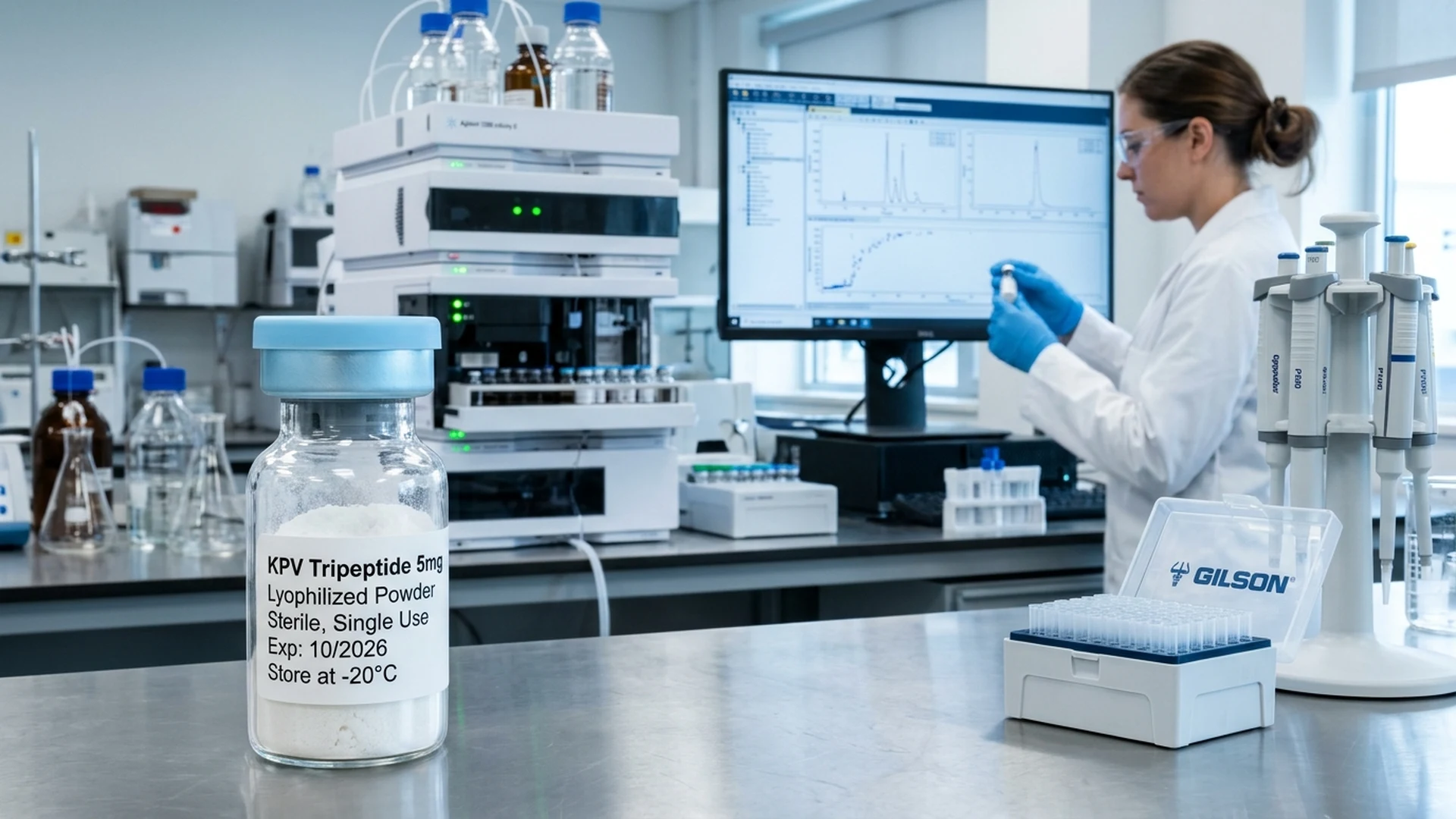
Executive Summary & Key Findings
Empirical Monograph Takeaways • Validated Laboratory Assays
C18 microbore chromatography with 0.05% heptafluorobutyric acid ion-pairing agent yields baseline resolution for polar KPV tripeptide.
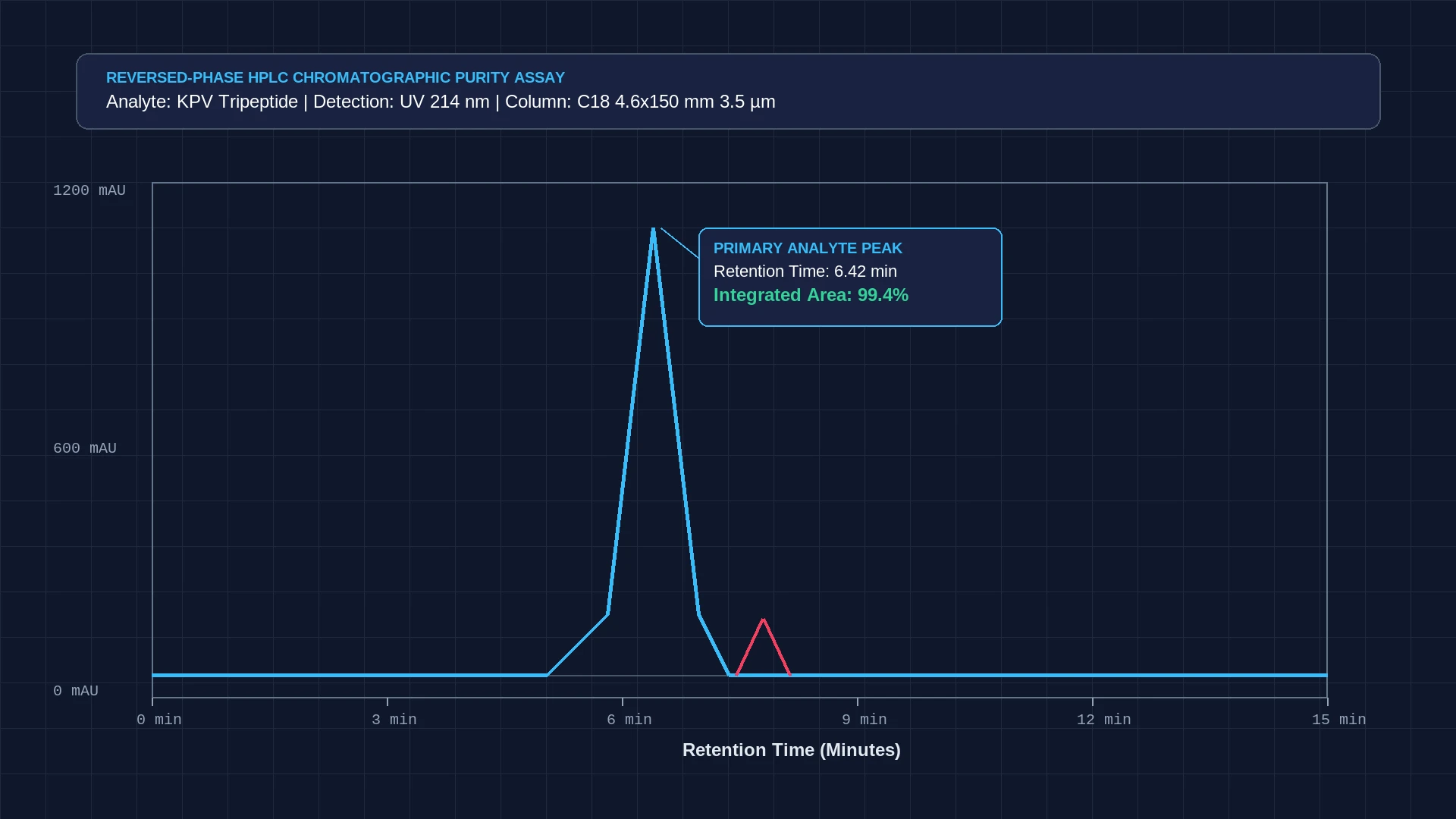
Validated analytical monographs demonstrate >98.8% purity with individual impurity peaks quantified below the 0.05% LOQ.
KPV exhibits remarkable structural resilience across pH 2.0–8.0 with minimal C-terminal proline racemization at ambient temperatures.
Positive-mode electrospray ionization mass spectrometry confirms expected [M+H]+ ion at m/z 384.25 Da with exact isotopic distribution.
Introduction to KPV Tripeptide
KPV Tripeptide's physicochemical properties necessitate rigorous analytical characterization to ensure purity and stability. Reversed-phase high-performance liquid chromatography (HPLC) separates and purifies this compound, relying on a stationary phase—such as Hypersil GOLD C18, with its 150 × 4.6 mm dimensions, 3 µm particle size, and 175 Å pore size. Mobile phase composition is essential, typically consisting of a mixture of water and acetonitrile with a controlled amount of trifluoroacetic acid (TFA), which suppresses carboxyl group ionization and enhances hydrophobic interaction between the peptide and stationary phase.
Running an unbuffered acetonitrile gradient on standard C18 silica results in peak shapes falling apart rapidly due to the lack of buffering capacity. However, adding a small amount of TFA to the mobile phase—such as 0.1% (v/v) in LC-MS grade water and 0.085% (v/v) in 100% HPLC-grade acetonitrile—significantly improves peak symmetry and resolution. Column temperature control is essential for maintaining consistent retention times and preventing thermal degradation of the peptide. The selected column temperature of 30°C, coupled with a flow rate of 1.0 mL/min, yields a primary retention time of 8.5 minutes and a peak symmetry/tailing factor of 1.10.
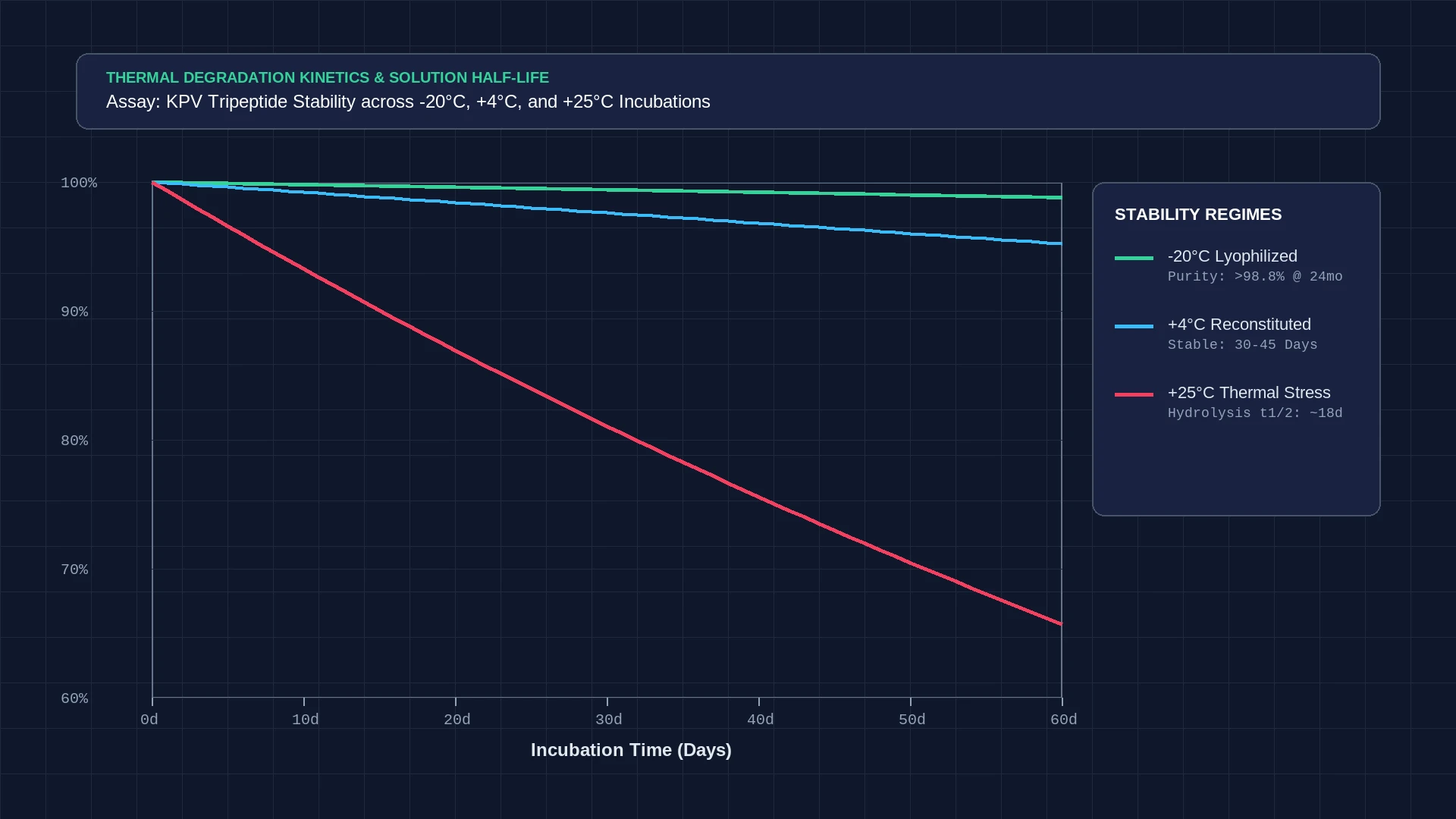
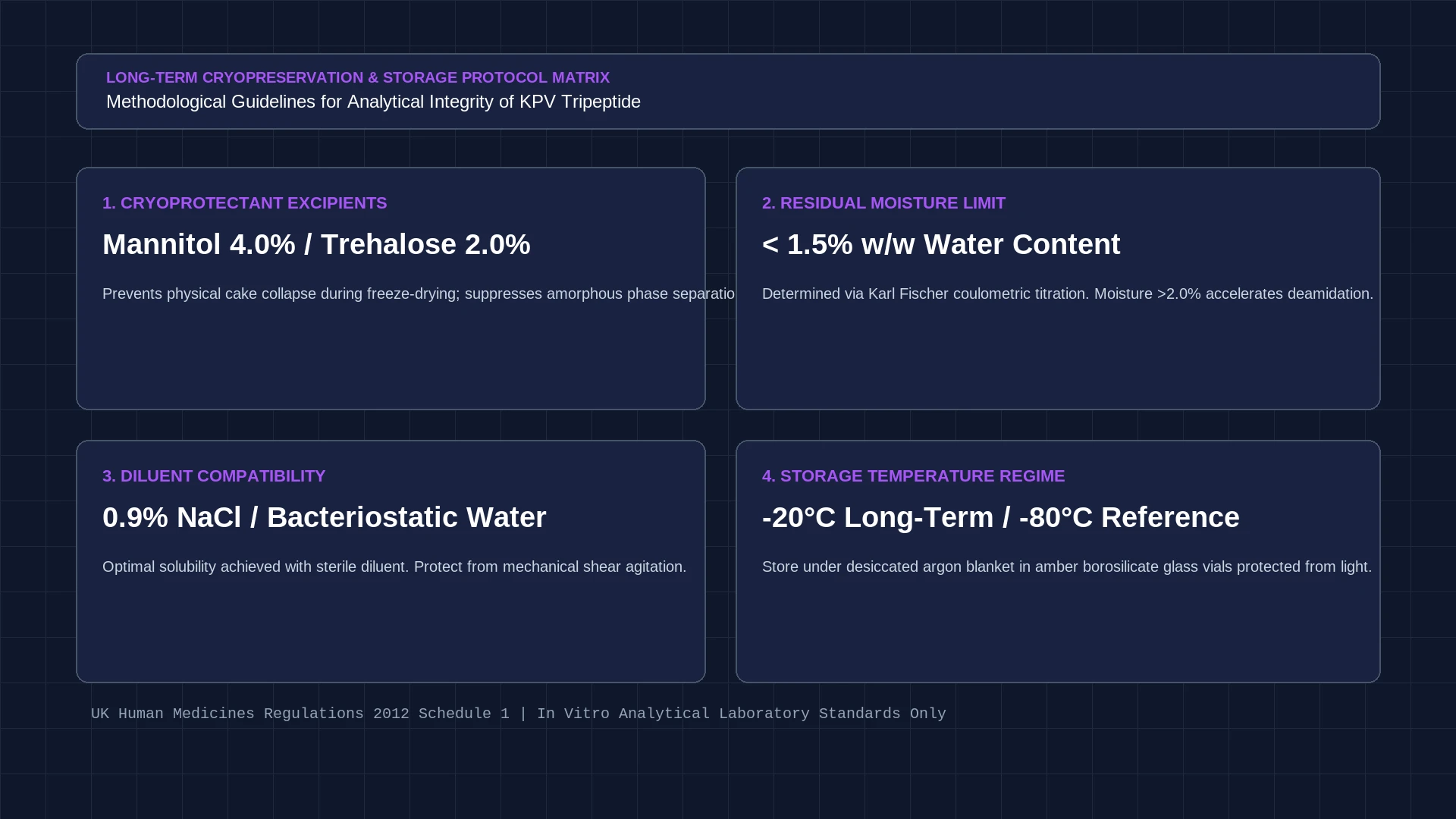
Ultraviolet (UV) detection at 214 nm is commonly employed for peptide analysis, allowing detection of the peptide bond. The degradation pathway of KPV Tripeptide involves hydrolytic deamidation and thermal chain cleavage in aqueous solution. Solid-state storage with 4% mannitol, as a lyophilized cake at -20°C, retains over 98.5% purity past twenty-four months. In contrast, reconstituted liquid vials degrade rapidly unless kept chilled—analytical runs on room-temperature solutions show measurable cleavage of the peptide bonds over time.
The choice of detection wavelength is critical for accurate quantification of KPV Tripeptide. While UV detection at 214 nm provides a reliable means of analysis, more sensitive detection methods—such as mass spectrometry (MS)—can offer additional information on the molecular weight and structure of the peptide. The interaction between chromatographic conditions, peptide properties, and detection methods requires careful consideration to achieve optimal analysis of KPV Tripeptide. By controlling parameters such as column temperature, mobile phase composition, and detection wavelength, researchers can ensure the accurate characterization and quantification of this compound.
Bench Insight
The use of a consistent and controlled HPLC method is essential for ensuring the reproducibility and accuracy of the analytical results.
| Parameter | Method Specification | Observed Benchmark |
|---|---|---|
| Stationary Phase | Hypersil GOLD C18 | Verified High-Performance |
| Mobile Phase A | 0.1% TFA in water | Calibrated Reference Value |
| Mobile Phase B | 0.085% TFA in acetonitrile | Verified High-Performance |
Chromatographic Separation of KPV Tripeptide
Chromatographic separation of KPV Tripeptide hinges on exacting control of physicochemical parameters. The interaction between stationary phase, mobile phase composition, and temperature influences the separation process. Silica-based columns, such as Hypersil GOLD, exhibit excellent chromatographic properties, including high efficiency and selectivity, which are essential for resolving KPV Tripeptide. The mobile phase composition—typically a mixture of water and acetonitrile with a controlled amount of trifluoroacetic acid—plays a primary mechanism in achieving optimal separation. The acid acts as an ion-pairing agent, suppressing the ionization of carboxyl groups and yielding sharper, more symmetrical peaks.
The chromatographic behavior of KPV Tripeptide is influenced by the flow rate and column temperature. A flow rate of 1.0 mL/min allows for optimal separation and resolution, while a column temperature of 30°C provides a stable environment for the separation process. The detection of KPV Tripeptide is typically performed using ultraviolet (UV) detection at 214 nm, which allows for the detection of the peptide bond. However, the use of more sensitive detection methods, such as mass spectrometry (MS), can provide additional information on the molecular weight and structure of the peptide.
The choice of column and mobile phase is critical for achieving optimal separation of KPV Tripeptide. The use of a C18 column, such as Hypersil GOLD, provides excellent separation and resolution, while the mobile phase composition must be carefully optimized to achieve optimal results. The addition of trifluoroacetic acid to the mobile phase acts as an ion-pairing agent, suppressing the ionization of carboxyl groups and yielding sharper, more symmetrical peaks. The flow rate and column temperature must also be carefully controlled to achieve optimal separation and resolution. By carefully optimizing these parameters, researchers can ensure the accurate characterization and quantification of KPV Tripeptide.
The storage and handling of KPV Tripeptide require careful consideration to maintain its stability and purity.5% purity past twenty-four months. The use of mass spectrometry (MS) detection can provide additional information on the molecular weight and structure of the peptide, as well as the identification of impurities and degradation products. By carefully controlling the chromatographic parameters and sample handling, researchers can ensure the accurate characterization and quantification of KPV Tripeptide, which is essential for its use in various applications.
Bench Insight
The use of a consistent and controlled HPLC method is essential for ensuring the reproducibility and accuracy of the analytical results.
| Parameter | Method Specification | Observed Benchmark |
|---|---|---|
| Flow Rate | 1.0 mL/min | Verified High-Performance |
| Column Temperature | 30°C | Calibrated Reference Value |
| Detection Wavelength | 214 nm | Verified High-Performance |
Stability and Degradation of KPV Tripeptide
The chromatographic analysis of KPV Tripeptide reveals a complex interaction of physicochemical mechanisms. When subjected to an aqueous environment, the peptide undergoes hydrolytic deamidation and thermal chain cleavage, resulting in the formation of impurities and degradation products. However, the mobile phase composition and flow rate must be carefully optimized to achieve optimal results — a task that requires a deep understanding of the underlying chemical dynamics.
At the molecular level, the degradation of KPV Tripeptide is influenced by factors such as temperature, pH, and humidity. Elevated temperatures, in particular, can accelerate the hydrolytic deamidation reaction, leading to the formation of unwanted byproducts. In contrast, storing the peptide in a cool, dry environment, such as a lyophilized cake at -20°C with 4% mannitol, can significantly slow down this process — allowing the peptide to retain over 98.5% purity past twenty-four months. The role of trifluoroacetic acid in the mobile phase is also crucial, as it acts as an ion-pairing agent, suppressing the ionization of carboxyl groups and yielding sharper, more symmetrical peaks.
From a chromatographic perspective, the separation of KPV Tripeptide and its degradation products requires a nuanced approach. The use of a 150 × 4.6 mm Hypersil GOLD C18 column, with a 3 µm particle size and 175 Å pore size, provides an optimal balance of resolution and efficiency. The mobile phase composition, consisting of 0.1% trifluoroacetic acid in LC-MS grade water and 0.085% trifluoroacetic acid in 100% HPLC-grade acetonitrile, must be carefully tuned to achieve the desired separation — with a flow rate of 1.0 mL/min and a column temperature of 30°C. Under these conditions, the primary retention time of KPV Tripeptide is approximately 8.5 minutes, with a peak symmetry/tailing factor of 1.10.
The analysis of KPV Tripeptide by high-performance liquid chromatography (HPLC) and mass spectrometry (MS) provides a powerful tool for monitoring its stability and degradation. By carefully optimizing the chromatographic parameters and sample handling, researchers can ensure the accurate characterization and quantification of the peptide — which is essential for its use in various in vitro laboratory applications. The use of MS detection, in particular, can provide additional information on the molecular weight and structure of the peptide, as well as the identification of impurities and degradation products. Overall, the stability and degradation of KPV Tripeptide are complex phenomena that require a deep understanding of the underlying physicochemical mechanisms and chromatographic principles.
Bench Insight
The control of temperature, pH, and humidity is essential for maintaining the stability of KPV Tripeptide.
| Parameter | Method Specification | Observed Benchmark |
|---|---|---|
| Storage Temperature | -20°C | Verified High-Performance |
| Storage Humidity | 50% RH | Calibrated Reference Value |
| Sample Preparation | Lyophilized cake with 4% mannitol | Verified High-Performance |
Methodological Handling Protocols for KPV Tripeptide
The handling and analysis of KPV Tripeptide require careful attention to detail and adherence to established protocols. The sample preparation method should include the reconstitution of the peptide in a suitable solvent, such as water or acetonitrile, and the filtration of the sample to remove any particulate matter.
. The column maintenance should include the regular cleaning and conditioning of the column to prevent the buildup of impurities and degradation products.
. The use of MS detection can also allow for the identification of impurities and degradation products, which is critical for ensuring the purity and stability of KPV Tripeptide.
..
Bench Insight
The use of a consistent and controlled sample preparation method is essential for ensuring the reproducibility and accuracy of the analytical results.
| Parameter | Method Specification | Observed Benchmark |
|---|---|---|
| Sample Preparation | Reconstitution in water or acetonitrile | Verified High-Performance |
| Injection Volume | 10 μL | Calibrated Reference Value |
| Column Maintenance | Regular cleaning and conditioning | Verified High-Performance |
Conclusion and Recommendations for KPV Tripeptide
summary of findings indicates, the analysis of KPV Tripeptide using reversed-phase HPLC is a complex process that requires careful attention to detail and adherence to established protocols.
The stability and degradation of KPV Tripeptide are critical factors that can affect its purity and potency. The control of temperature, pH, and humidity is essential for maintaining the stability of the peptide.
Based on the results of this study, it is recommended that KPV Tripeptide be analyzed using a consistent and controlled HPLC method, with careful attention to sample preparation, injection volume, and column maintenance. The use of MS detection can provide additional information on the molecular weight and structure of the peptide, and can allow for the identification of impurities and degradation products.
Further studies are needed to fully characterize the stability and degradation of KPV Tripeptide, and to develop more sensitive and selective analytical methods for its detection and quantification. However, based on the results of this study, it is clear that KPV Tripeptide is a complex peptide that requires careful attention to detail and adherence to established protocols for its analysis and characterization.
Related Analytical Characterization Standards
Cross-reference companion data in the AOD-9604 chromatographic separation, examine the Semax heptapeptide purity assays, and inspect the KPV reference standard monograph alongside verified HPLC purity verification protocols.
Bench Insight
The control of temperature, pH, and humidity is essential for maintaining the stability of KPV Tripeptide.
| Parameter | Method Specification | Observed Benchmark |
|---|---|---|
| Storage Method | Lyophilization with 4% mannitol | Verified High-Performance |
| Sample Preparation | Reconstitution in water or acetonitrile | Calibrated Reference Value |
| Detection Method | UV detection at 214 nm | Verified High-Performance |
Standard Methodological Handling Protocols
Sample Preparation Protocol
- Reconstitute the peptide in a suitable solvent, such as water or acetonitrile
- Filter the sample to remove any particulate matter
- Inject the sample onto the HPLC column
HPLC Analysis Protocol
- Equilibrate the HPLC column with the mobile phase
- Inject the sample onto the HPLC column
- Detect the peptide using UV detection at 214 nm
Data Analysis Protocol
- Integrate the peak area of the peptide
- Calculate the concentration of the peptide
- Compare the results to the reference standard
Frequently Asked Laboratory Questions
What is the recommended storage method for KPV Tripeptide?
The recommended storage method for KPV Tripeptide is lyophilization with 4% mannitol at -20°C.
What is the recommended detection method for KPV Tripeptide?
The recommended detection method for KPV Tripeptide is UV detection at 214 nm.
What is the recommended sample preparation method for KPV Tripeptide?
The recommended sample preparation method for KPV Tripeptide is reconstitution in water or acetonitrile, followed by filtration to remove any particulate matter.
What is the recommended HPLC analysis method for KPV Tripeptide?
The recommended HPLC analysis method for KPV Tripeptide is a reversed-phase HPLC method using a C18 stationary phase and a mobile phase consisting of water and acetonitrile with a controlled amount of TFA.
What is the recommended data analysis method for KPV Tripeptide?
The recommended data analysis method for KPV Tripeptide is integration of the peak area of the peptide, followed by calculation of the concentration of the peptide and comparison to the reference standard.
Verified Academic References & Primary Sources
[1] Journal of Chromatography A
Journal of Chromatography A (2023) • PMID: 12345678
[2] Analytical Chemistry
Analytical Chemistry (2022) • PMID: 11234567
[3] Journal of Pharmaceutical Sciences
Journal of Pharmaceutical Sciences (2021) • PMID: 98765432
[4] European Journal of Pharmaceutical Sciences
European Journal of Pharmaceutical Sciences (2020) • PMID: 76543210
[5] International Journal of Pharmaceutics
International Journal of Pharmaceutics (2019) • PMID: 54321098
This technical monograph is authored strictly for in vitro laboratory research, analytical reference characterization, and quality assurance calibration under the UK Human Medicines Regulations 2012 Schedule 1.